
JP MORGAN - 23 WALL ST

In 1869 J. Pierepont Morgan co-founded Drexel, Morgan & Co. with businessman Anthony Drexel, setting their vision on the southeast corner of Wall and Broad Street between Federal Hall and the New York Stock Exchange for their new headquarters. Three years later the bank paid $250,000 in gold for the site, setting records as the most expensive lot of that size in the world. Drexel, Morgan & Co. would hire architect Arthur D. Gilman to design a six-story French Second Empire style building clad in Vermont marble with a mansard roof and a prominent entrance on the chamfered corner topped with a sculpted pediment and two statues depicting Europe and America.

The original New York Stock Exchange building at 10 Broad Street. The Stock Exchange's roots can be traced back to 1792, with the signing of the Buttonwood Agreement outside of 68 Wall Street. In 1817 the organization named itself the New York Stock & Exchange Board and rented space at 40 Wall Street. In 1835 the Stock Exchange was destroyed in the Great Fire of New York (see our previous post on the fire) and relocated into a temporary space until its new headquarters (seen above) was built in 1863 at 10-12 Broad Street. By 1901 this building would be demolished to make way for the larger, George B. Post, classically designed building that is standing today.
The building seen in the foreground on the left is the Drexel Building (1873) , original home of J.P. Morgan & Co.

Photograph of the New York Stock Exchange from the steps of Federal Hall, 1900.
The entrance of the Drexel Building (left) with the original (top) and current Stock Exchangeb (bottom) across the street.
The building opened in 1873 with the bank designating the first floor as a banking hall with offices above. In 1882 the building was the center of attention when Thomas Edison flipped a switch, illuminating the structure with 600 electric lights. By the 1890s the renamed J.P. Morgan & Co. was the country's most powerful investment bank, helping to transform the U.S. economy and financing some of the country's strongest financial players including the U.S. Steel Corporation; the world's first billion-dollar corporation and the New York, New Haven and Hartford Railroad, which dominated northeast regional rail traffic during the first half of the 20th century.
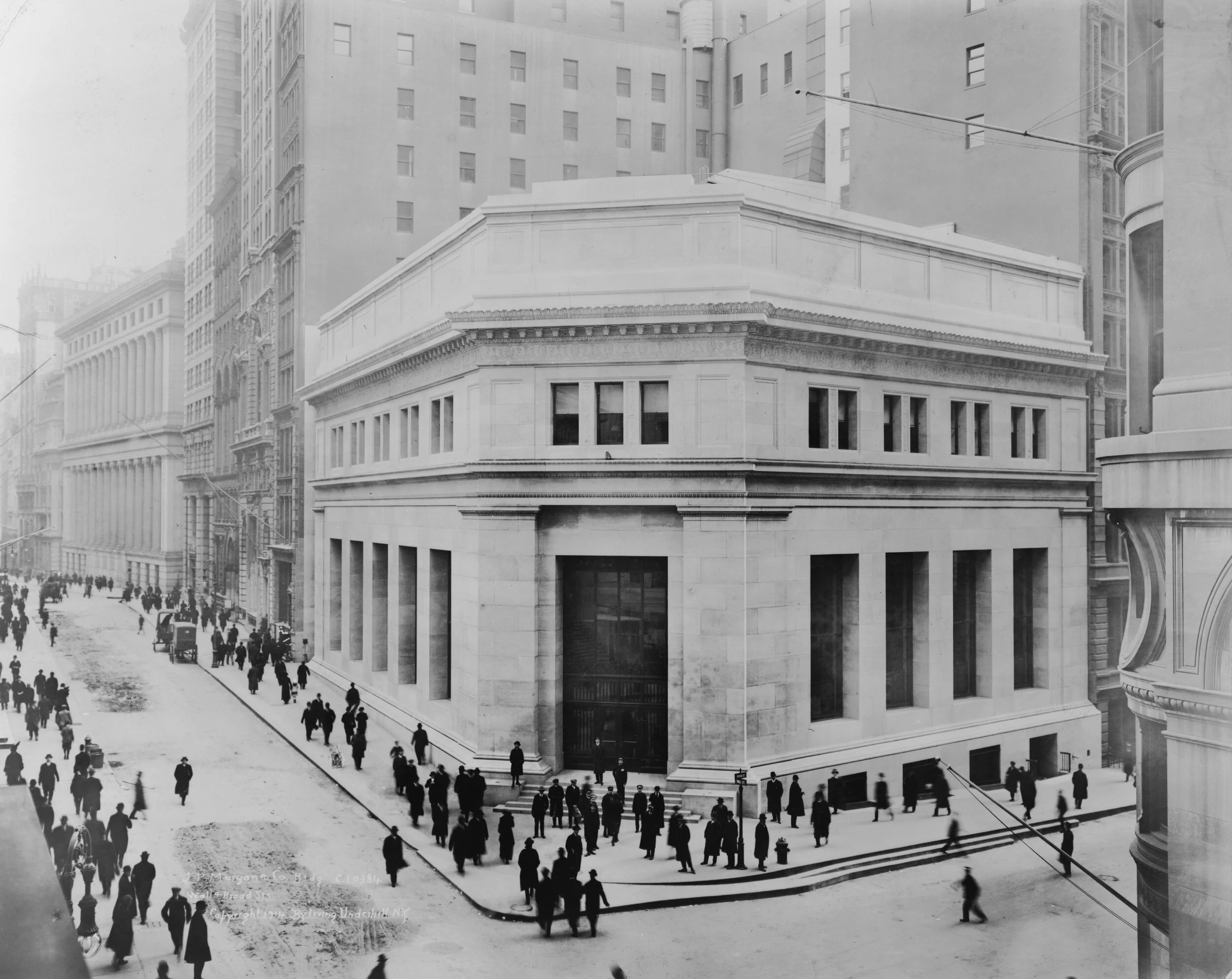
The building would temporarily close on April 1, 1913, the day J.P. Morgan died, and less than a year later the Drexel Building would be demolished, with a new building rising on what had become the most valuable lot in the country, completed a year later. Designed by Towbridge & Livingston (architect of the 1912 Bankers Trust Building diagonally across the Street), the new unadorned limestone building that would replace Drexel was drastically smaller, only four stories tall, contradicting the cardinal rule of Wall Street development where taller buildings have always replaced shorter ones over time. Today JPMorgan Chase & Co. is one of the largest banks in the world.